
At around 15:54 on Thursday 13 August 2026, train 1F34, the 14:24 London Victoria to Eastbourne passenger service, operated by Southern (Greater Thameslink Railway), derailed at Lewes in East Sussex. The derailment took place around 1 mile (1.6 kilometres) north of Lewes station.
Train 1F34 was formed of eight vehicles. The rear three vehicles derailed and subsequently overturned during the accident, coming to rest on their sides on the railway’s embankment. The front five vehicles did not derail.
Around 150 people were on the train when it derailed. There were 30 people injured in the accident, with 20 people requiring hospital treatment, some with serious injuries. Significant damage was caused to the train and to railway infrastructure.
RAIB was notified of the accident at 16:02 and immediately deployed a team of inspectors and support staff to the site, with the first inspectors arriving at 19:11. RAIB’s team worked alongside the British Transport Police, the Office of Rail and Road, and the railway companies involved, to secure and recover the necessary evidence to support our independent safety investigation.
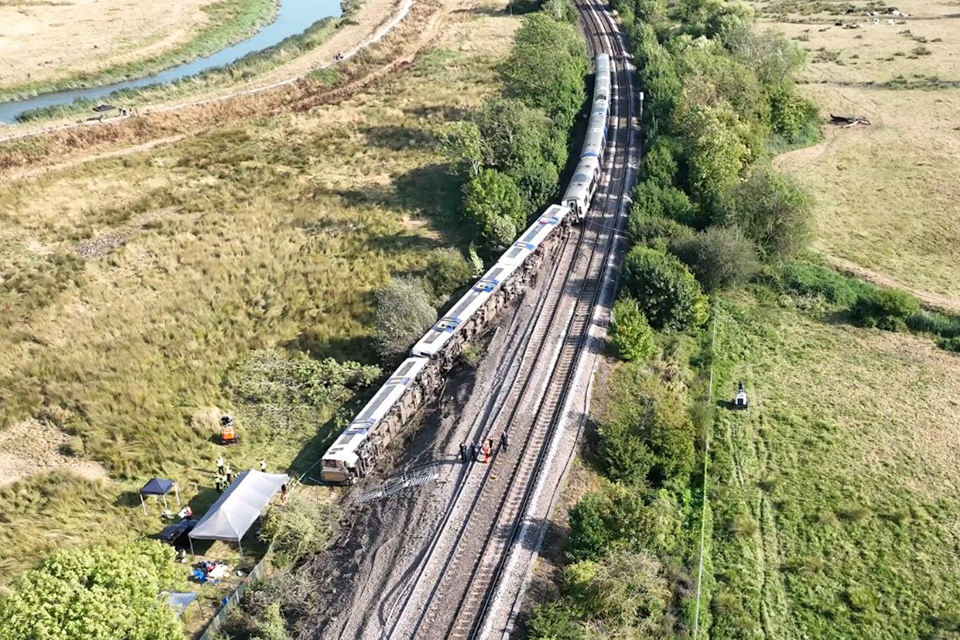
Aerial view of the site (courtesy of Network Rail).
RAIB released the site of the accident to Network Rail at 14:09 on Saturday 15 August 2026, to allow for repair of the infrastructure and recovery of the train. RAIB inspectors and support staff continued to work at the site of the accident until Monday 17 August.
The recovery of the train will be complex and will include the derailed vehicles being lifted by rail crane and moved by road to secure storage. RAIB’s liaison with rail industry recovery teams to facilitate this work, and to ensure that evidence is preserved, is ongoing.
Data from the on-train data recorder (OTDR, sometimes called ‘the black box’) from the front vehicle of train 1F34 has been downloaded, and is currently being analysed. Data from the remaining recorders on the train will be obtained during recovery operations. CCTV recordings, signalling data and radio communications data have also been obtained. The train, track, and embankment at the site of the accident have been examined and surveyed by various methods including laser scanning and aerial photography.
The accident took place on Network Rail’s East Coastway line, between Cooksbridge station and Lewes Tunnel. The railway here has two tracks. These are the Up Lewes and Down Lewes lines (which direct trains towards London, and away from London, respectively). The derailment took place on the Down Lewes line at around 48 miles and 60 chains, where the maximum permissible speed for the type of train involved in the accident is 70 mph (113 km/h).
Train 1F34 was formed of two class 387 electric multiple units (EMUs) coupled together, each consisting of four vehicles. Preliminary analysis of OTDR data obtained from the front vehicle shows that the train was travelling at around 65 mph (105 km/h) as it approached the point of derailment. Preliminary OTDR data analysis also shows that the driver applied the train’s brakes as it passed the point of derailment, and that the train started to decelerate.
Marks observed on the rails near the point of derailment are consistent with the wheels of the derailed rear vehicles having climbed over the rails. Forward‑facing CCTV images from train 1F34 and forward and rearward‑facing CCTV images obtained from preceding services using these lines on 13 August show that a track geometry irregularity existed on the immediate approach to the point of derailment, prior to the accident occurring.
There was also evidence of previous track maintenance activity in this area. Following the accident, RAIB has received several reports of rough riding at the location of the derailment from passengers on other trains. RAIB continues to analyse evidence relating to the derailment sequence and the status of the track.
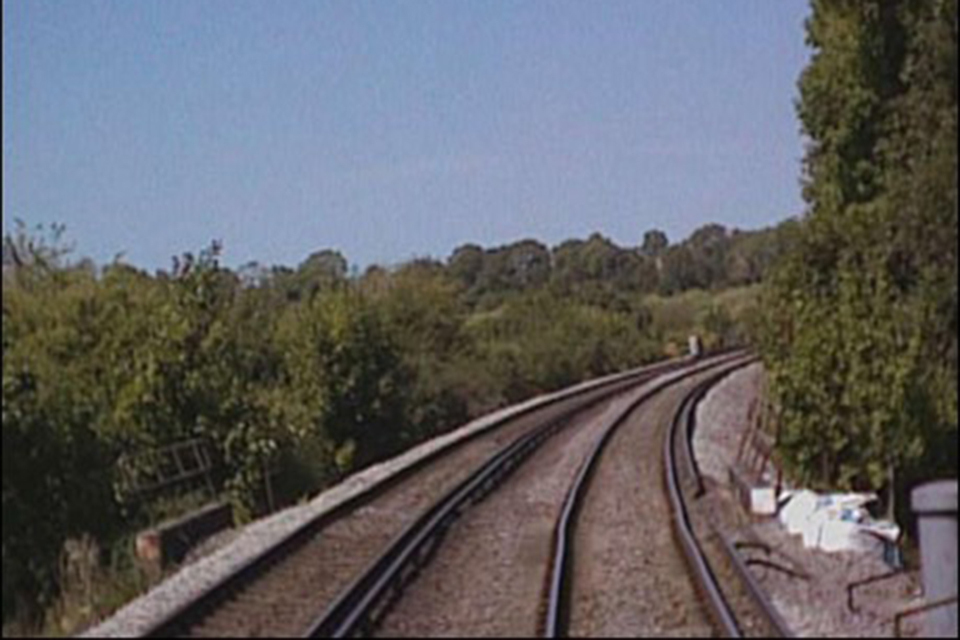
Rear-facing CCTV image from a train which passed the location of the accident at about 14:04 on the afternoon of 13 August 2026 (the irregularity is visible adjacent to the white ballast bags) (courtesy of Greater Thameslink Railway).
The weather on the day of the accident was hot and sunny, with little wind. The ambient air temperature at the time of the derailment was recorded as being around 27 degrees Celsius by the nearest weather station to the accident (which was at Brighton City Airport). The accident took place during a sustained period of hot and dry weather.
The embankment on which the railway runs at this location is constructed of clay and sits on alluvial/alluvium deposits (consisting of loose clay, silt, sand and gravel). Both are sensitive to variations in water content and may undergo movement as moisture levels change. Although, at this stage, there is no evidence to indicate that a significant embankment slip occurred before the accident, there is evidence that some movement had previously taken place.
Our investigation will seek to identify the sequence of events which led to the accident. It will also consider:
- the exact mechanism by which train 1F34 derailed
- the status of the track at this location and how it was inspected and maintained
- the condition of the embankment, including the presence of any coincident risk factors (such as sustained hot weather, nearby structures, and vegetation), and how it was inspected and maintained
- the weather conditions in the area on the day of the accident, and in the weeks and months preceding it
- the effectiveness of any mitigation measures intended to address the risks of operating trains in hot weather
- the condition of train 1F34 and the crashworthiness performance of the rear three vehicles of the train during the derailment
- the emergency response to the accident
- any relevant underlying factors, including any actions taken in response to previous relevant safety recommendations.